
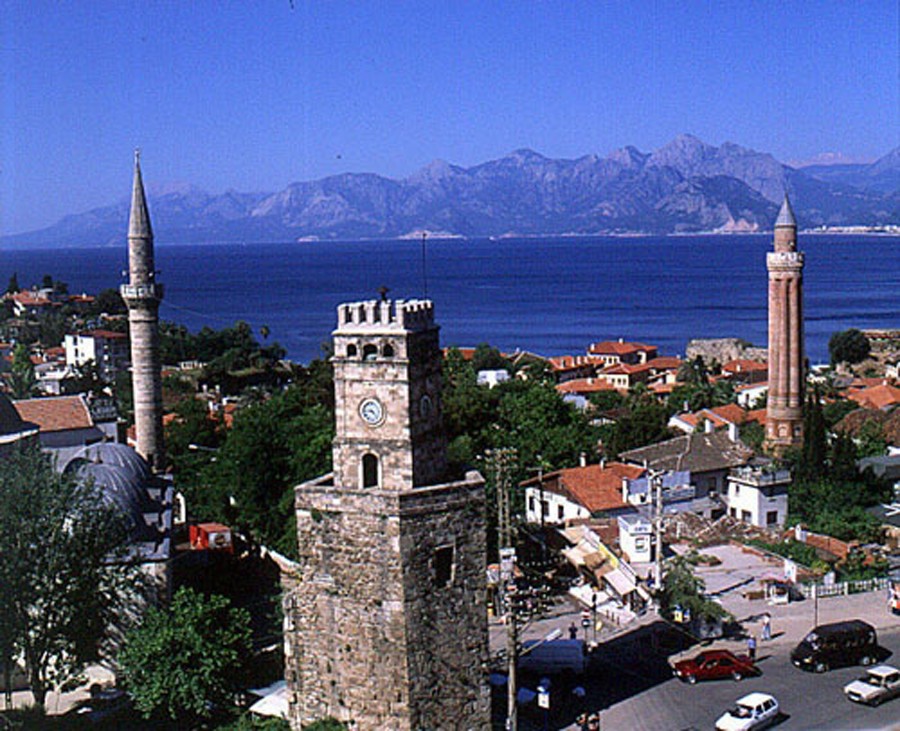
Gazi Mustafa Kemal Atatürk, who visited Antalya three times, observed the view of the sea, the beaches, and the snow-capped Taurus Mountains from Lara during his first visit on March 6, 1930, and said: "There is no doubt that Antalya is the most beautiful place in the world."
Gazi Mustafa Kemal Atatürk, who visited Antalya three times, observed the view of the sea, the beaches, and the snow-capped Taurus Mountains from Lara during his first visit on March 6, 1930, and said: "There is no doubt that Antalya is the most beautiful place in the world."
History of Antalya
Antalya, meaning "Home of Attalos", was founded by Attalos II. The city, which remained independent for a while with the end of the Kingdom of Pergamon (133 BC), later fell into the hands of pirates. In 77 BC, it was annexed to Roman territory by Commander Servilius Isauricus. In 67 BC, it became the base for Pompey's navy. Hadrian's visit to Attaleia in 130 AD ensured the development of the city. Attaleia, which was considered an episcopal center during the Byzantine rule, showed great development after the conquest by the Turks. Since the modern city was built on top of the ancient settlement, there are very few ancient ruins in Antalya. The first visible remains are part of the harbor mole, referred to as the old harbor, and the city walls surrounding the harbor. Hadrian's Gate, restored in the part of the walls outside the park, is one of the most beautiful ancient monuments of Antalya. The city of Antalya and its surroundings were called Pamphylia in ancient times, meaning "very fertile", and Lycia in the western part. Those who migrated here from the western shores of the Aegean since the 8th century BC founded cities like Aspendos and Side. King Attalos II of Pergamon, who reigned in the middle of the 2nd century BC, besieged Side. It is about 75 km from Antalya. The king, who could not take Side in the east, came to the place where the current city center is located and founded a city. This place was named Attaleia after him. Over time, there were people who called it Atalia, Adalya. Antalya is named after him. Archaeological excavations have proven that people lived in Antalya and its region 40,000 years ago. The region since 2000 BC came under the rule of city-states such as Hittite, Pamphylia, Lycia, Cilicia, and Persia, Alexander the Great and Antigonus, Ptolemies, Seleucids, the Kingdom of Pergamon, which is considered his successor. Later, the Roman state ruled. The ancient name of Antalya was Pamphylia and the cities founded here had their heyday especially during the 2nd and 3rd centuries. Towards the end of the 5th century, it lost its former glory. While the region was under the rule of the Byzantines, known as East Rome, it was connected to Turkish lands by the Seljuks in 1207. During the Anatolian principalities, it came under the rule of Hamitoğulları, a branch of the Teke tribe. The Teke Turkmens are one of the most populous tribes in today's Turkmenistan, the former homeland of the Turks. In the 11th century, some of them came here. Today, the Lakes Region, which is north of Antalya and covers part of Isparta and Burdur, is also called the Teke Region. The center of the Teke Sanjak of the Anatolian province during the Ottoman period was today's Antalya city center. In those years, it was called Teke Sanjak. The current name of the province is actually a slightly modified form of its old name and was given during the Republican period. The famous Ottoman traveler Evliya Çelebi, who came to Antalya in the second half of the 17th century, states that there are four neighborhoods and three thousand houses inside the castle and 24 neighborhoods outside the castle. The city's bazaar was located outside the castle. According to Evliya Çelebi, the port is large enough to accommodate 200 ships. Administratively, Antalya, which was the center of Teke Sanjak and belonged to Konya, was transformed into an independent Sanjak in the last years of the Ottoman Empire.
Sightseeing in Antalya
Antalya, one of the tourism paradises of our country, almost doubles its population every summer. Thousands of local and foreign tourists who want to cool off in the deep blue and clean waters of the Mediterranean flock to the city in the summer months. In this season, hotels in Antalya are almost overflowing. With sea, sand, sun, natural, and historical beauties, Antalya appeals to every taste and mood, bringing color to faces in the summer months. Whether you want to enjoy entertainment that lasts until morning in entertainment venues or retreat to a quiet bay and rest your head. Tired of the heat of Antalya? Turn to the waterfalls. Want to add some cultural character to your holiday? Listen to the old stories of the past by visiting ancient cities and historical buildings.
Places to Visit
Karain Cave:
Karain, one of the largest naturally formed caves in our country, is a deeply rooted natural entity that is 500,000 years old. The Karain Cave also provides very important information about the history of Anatolia and the Near East. We recommend you visit this natural wonder, whose history dates back 500,000 years, and breathe the extraordinary atmosphere it will offer you.
Düden Waterfall:
The Düden Waterfall, one of the first places that come to mind when Antalya is mentioned, is one of the paradisiacal corners of our country. Düden, one of the first stops for those who want to get rid of the scorching heat of Antalya for a bit, always keeps its coolness. In the promenade area around the waterfall, there are facilities that leave nothing to be desired.
Kurşunlu Waterfall:
Consisting of the combination of 7 different small waterfalls, the Kurşunlu Waterfall fascinates those who see it with its extraordinary beauty. We guarantee that you will immediately forget all worries in the face of the lush nature surrounding the waterfall, which is located in a 2 km long canyon. If you are among those who like to take photos, this waterfall offers excellent poses for your frame, let us tell you!
Manavgat Waterfall:
The Manavgat Waterfall, one of the places where reality is more beautiful than the photos, has become one of the landmarks of the city today. You should definitely see this natural beauty where a thousand and one shades of green and blue are in harmony.
Saklıkent Ski Center:
Although Antalya is one of the points identified with the trio of sea, sand, and sun of our country, it is actually one of the rare cities that are beautiful in every season. If you happen to be in Antalya during the winter months, the Saklıkent Ski Center might be the ideal place for you. You can have an extraordinary experience skiing in the Taurus Mountains of Antalya.
Aspendos:
Aspendos, one of the rare ancient theaters that has remained intact in one piece, witnesses history today with its thousand-year history. Take a seat in Aspendos, which has a legendary history, and listen to the old stories the stones will tell you.
Ancient City of Termessos:
The ancient city is located in the Güllük Mountain National Park and is famous as the place where the Dog Sarcophagus in the Antalya Museum was found. Termessos, which was famous for resisting the raids of Alexander the Great for a while, continued its existence independently in many eras of history. You can visit the ancient city of Termessos for a fee of 5 TL. However, if you have a Museum Card (Müzekart), you can start your journey for free.
Ancient City of Xanthos:
The ancient city of Xanthos, which differs from other ancient cities with its breathtaking sea view and fine handmade motifs, welcomes its visitors with the dignity of being 3000 years old. Despite its very old history, it also attracts attention as it is one of the strongest ancient cities of our country.
Arykanda Ruins:
You do not have to pay any fees for entry to the Arykanda Ruins, which contain findings from the 5th century BC. The ancient city, which was excavated by a researcher named Fellows, was hidden in the forests for many years. You can visit the ruins of Arykanda after 08:00.
Side Antique Theatre:
This historical building, which is a mixture of Hellenistic and Roman architecture, has a magnificent 3-story stage. You can visit the ancient theater, which contains various decorations and sculptures, for free with the Müzekart. If you do not have a museum card, you have to pay 15 TL at the entrance.
Ancient City of Rhodiapolis:
It is estimated that the ancient city in Kumluca was founded by the Rhodians. The name of this city, which was dominated by the Rhodesians who were colonizing at that time and were a very effective power, is first mentioned in the sources of Hecataeus. It is possible to see the remains of many structures such as necropolis, theater, and church in the ancient city. You do not have to pay any fees for ancient city visits.
Ancient City of Selge:
Although the ancient city, which is located within the borders of the Manavgat district, was under Persian rule for a while, it continued to exist as an independent city for most of history. In the ancient city, which was restored in the 3rd century BC, there are structures such as a stadium, theater, and basilica.
Ancient City of Phaselis:
In the ancient city of Phaselis, which is surrounded by walls, there are very important structures. Although the exact date of the foundation of the ancient city in the Kemer district is not known, it is estimated to the 7th century BC. You have the opportunity to visit the ancient city for free with the Müzekart; the entrance fee is 20 TL.
Ancient City of Perge:
The architecture of the ancient city of Perge, which welcomes its visitors with its magnificent theater, bears traces of the Hellenistic period. In the ancient city, next to the stadium meticulously preserved to this day, is the famous Plancia Magna Sarcophagus. Also, the entrance gate and the walls of the city are definitely worth seeing. If you have a museum card, you can visit the ancient city for free, where the entrance fee is 25 TL.
Kaleiçi - Old Town of Antalya:
Since the 4th century BC, Kaleiçi has been the cradle of many different civilizations. Although it has worn out over time, its beauty is still present. Kaleiçi, which gives you life energy with its harbor, colorful cute houses, and the glittering sea, has a truly unique atmosphere. If you are a lover of nostalgia, you can travel to the past with the old shops, inns, and baths of Kaleiçi.
Antalya Clock Tower:
The Antalya Clock Tower, located in one of the bastions of Kaleiçi, was built in 1901 by the German Emperor Wilhelm II. It was gifted to Abdülhamid. After drinking your tea in front of the striking view of the tower, you can closely examine the architecture of the tower, which fascinates with every detail.
Hadrian's Gate:
Also called Üçkapılar (The Three Gates) by the locals, Hadrian's Gate has a very old history. The building on the walls was built in 130 AD in honor of the Roman Emperor Hadrian. We recommend you add the building, which has not lost its charm since then, to your sightseeing list.
Alanya Castle:
Alanya Castle, which is today described as an open-air museum, belongs to the sights of the city due to its location. The destructive hand of time has not touched Alanya Castle. The wall length of the still preserved Alanya Castle is more than 6 km. The castle with 140 bastions and 400 cisterns is one of the rarest examples of Seljuk architecture. Entry to Alanya Castle, which you can visit at any time, costs 15 TL.
Kesik Minaret:
Although it is not actively used, the Kesik Minaret (Broken Minaret), which is one of the landmarks of Kaleiçi, welcomes many visitors. It was also called Şehzade Korkut Mosque because it was converted into a mosque by Şehzade Korkut. You should not end your Antalya trip without photographing this magnificent minaret, which was restored after a fire in 1974.
Muratpaşa Mosque:
The Muratpaşa Mosque, which has existed since the 16th century, attracts attention with its unique craftsmanship and especially its pulpit. The mosque, which is located within the borders of the Muratpaşa district, will be one of the unforgettable moments of your trip.
Yivli Minaret:
The Yivli Minaret (Fluted Minaret), which was added to the structure built by the Seljuk ruler Alaaddin Keykubat, is one of the first examples of Islamic structures in Antalya. It is among the rare examples of its kind worldwide.
Hıdırlık Tower:
The tower, which has an imposing appearance, was used as a lighthouse to observe the ships. The tower, which has a cylindrical structure, amazes especially with its solidity.
Lycian Way:
The road to the Gelidonya Lighthouse, which holds the prize for the best landscape in our country, amazes everyone with its unique nature. The Lycian Way, where green and blue harmonize, is a natural studio for lovers of photography. Moreover, it is very popular among those who want to undertake trekking or bike tours.
* By the way, we are very often asked about shopping facilities and other various opportunities in the respective villages and towns. Since this topic is very extensive, we have set up the 'Insider Club' platform for this purpose, where you can find all kinds of information about shopping, events, activities, food & drink, and much more.


Guest Experiences & Forum
Leave a comment
In this comment function you have the possibility to leave comments. It doesn't matter whether you have questions, suggestions, additions or ideas about this article or whether you would like to exchange views on our topics - we are curious about your contributions!